
Run your welding operations, from the shop floor to the records.
Projects, welds, inspections, WPQ, WPQR, WPS, in a single dedicated environment.
An offer suited to your needs
Guided forms to create WPQ, WPQR and WPS step by step under ISO and ASME. Ranges of qualification calculated, in-house WPQ revalidation in a few clicks.
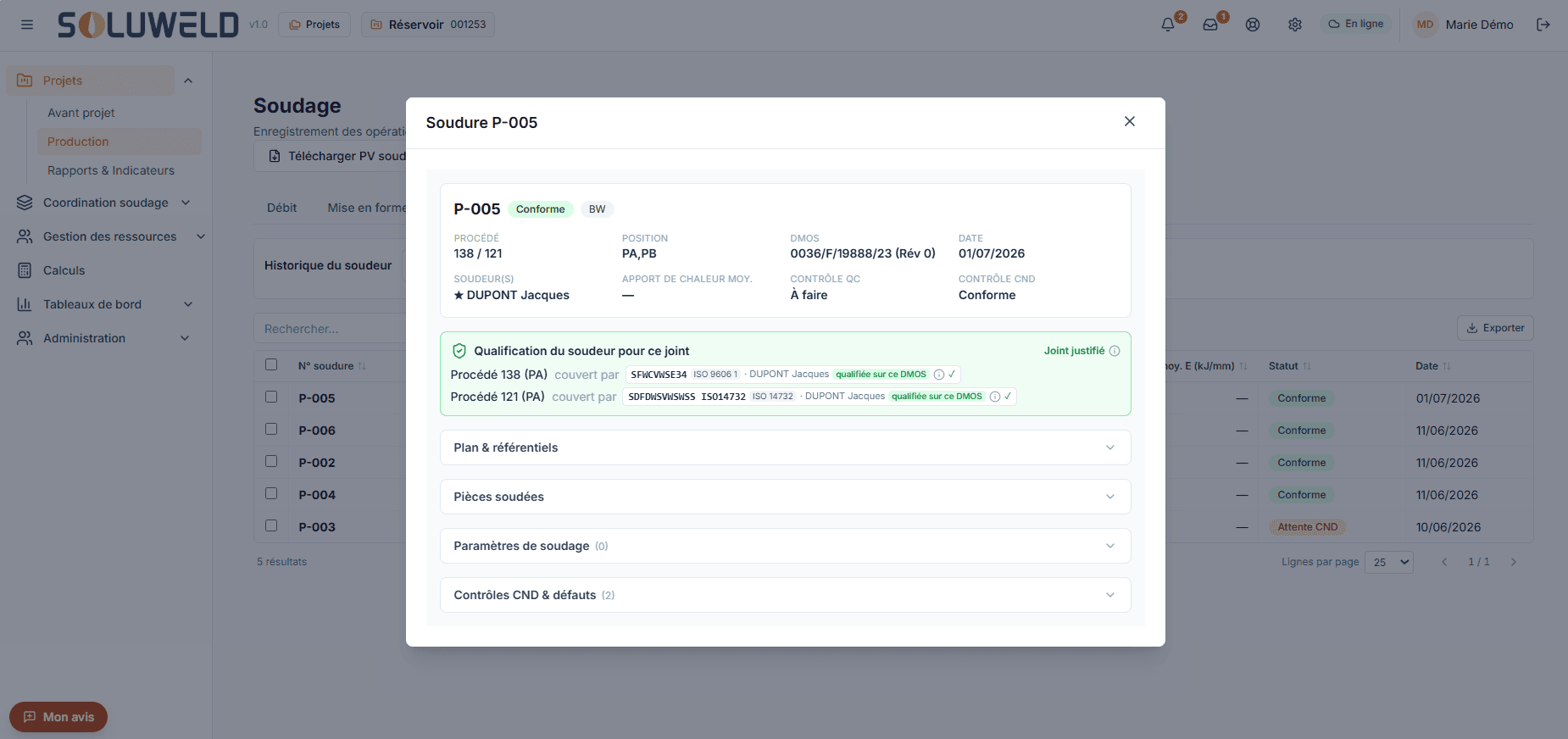
Each weld is linked to its welder, their qualification and its WPS.
Built as production goes, exportable to PDF on demand.
Unlimited users on a single production site. Estimate your cost with the simulator.
→Operational control produces compliance.
Every weld subject to a regulatory requirement is linked to a welder qualification and to a WPS covered by a WPQR. All these documents feed the manufacturing record, proving the company's operational control over a given fabrication. This is why welding coordination is essential for each activity to fit together in line with the standards.
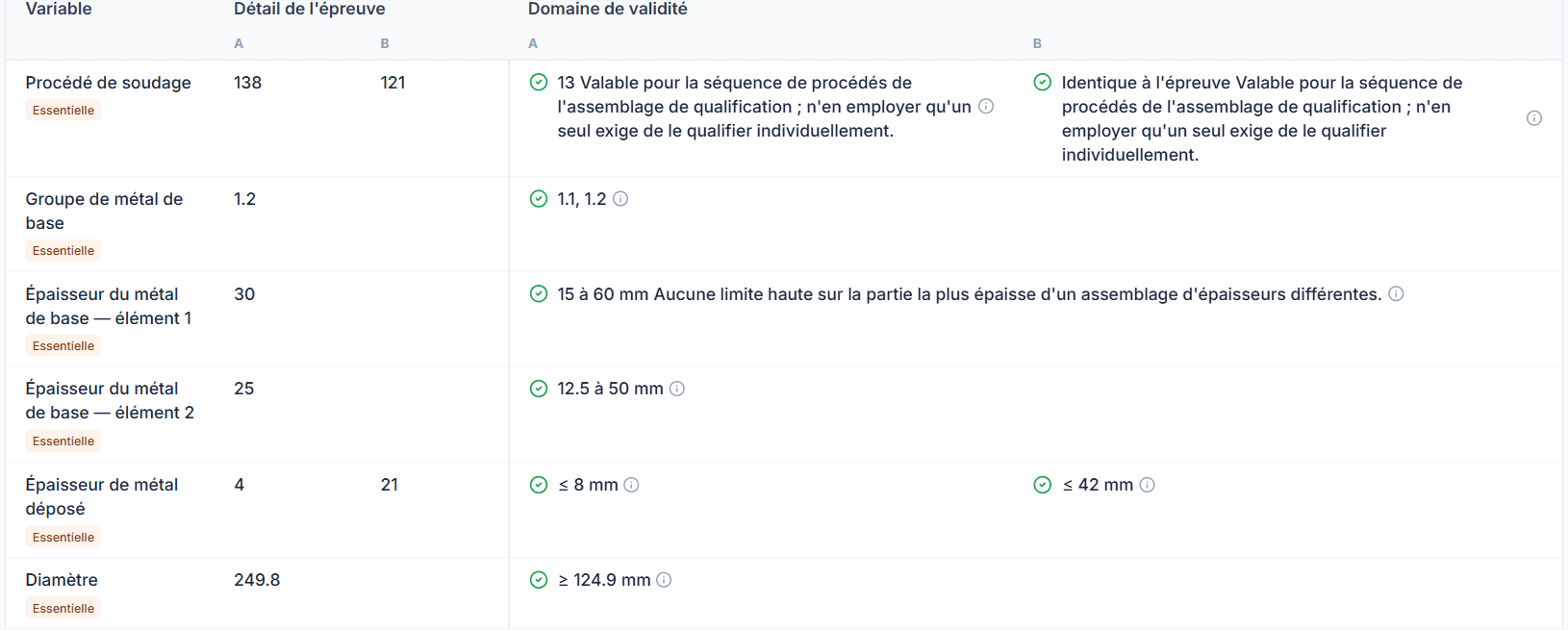
The range of qualification is calculated, variable by variable.
Each variable cites the clause of the standard that governs it.
The record builds up as production goes.
You enter each qualification, each WPQR, each WPS, each weld and each inspection only once. The data entered is then linked to the rest. The weld log and the manufacturing record are available at all times, up to date, and exportable on demand.
Many tools touch welding. Very few are designed to coordinate it.
ISO/TR 15608 steel groups: carbon, low-alloy, stainless and duplex steels. Nickel-base fillers accepted for 9% Ni steels.
Covered electrode (111-SMAW), submerged arc (12x-SAW), MIG/MAG (13x-GMAW), flux-cored wire (114-FCAW-S / 13x-FCAW-G), TIG (141-GTAW), plasma (15x-PAW), oxy-acetylene (311-OFW).
Qualification of welders, operators and procedures, quality requirements, inspection and acceptance.
International Welding Engineer (IWE)
Since 2024
Founder of SoluWeld
“I built SoluWeld so engineers and technologists can focus on high-value subjects — technical arbitration, continuous improvement, new method development — and leave compilation and documentary checks to the software. Human expertise where it counts. Automation where it frees.”
Frequently asked questions
Do I need to be an IWE — or have one on staff — to use SoluWeld?
No. SoluWeld builds the standards checks and consistency rules directly into the software, so someone with only a basic welding background can run a welding activity. IWE/IWT expertise remains valuable for technical decisions (material variants, exceptions to the standards), not for data entry or compilation.
How long to migrate from our Excel files?
Your WPQ, WPQR, WPS, parts and welds are imported from spreadsheets, using templates provided by the software: a single import assistant, with a screen that shows conflicts before anything is written. We support the first 10 imports during onboarding. Your existing data remains usable.
How can I try SoluWeld today?
SoluWeld is in the final stage of development. The public free trial is not open yet. In the meantime, book 30 minutes on video with the founder: we look at your actual case on the real software screens and identify the time savings on records and standards for your scope.
Is my data hosted in Europe?
Yes. All your data is hosted in datacenters located in the European Union. Daily encrypted backups. GDPR compliant. No third-party access to your project data.
Which codes and materials does SoluWeld cover?
At launch: steels, arc and oxy-fuel welding, and the ISO codes (ISO 9606-1, ISO 14732, ISO 15614-1, ISO 3834) and ASME IX, among others. Developing new codes and materials is part of our roadmap, so do let us know what you need.
What happens if I exceed my planned volume?
Nothing is blocked: there is no threshold and no package. Each declared weld is charged €2.50, each inspected weld €3.50. Your compliance never stops for a pricing reason. Your monthly payments are simply adjusted.
Evaluate the platform on your real projects.
Thirty minutes on video to measure the time saved on records and the autonomy SoluWeld brings to your teams.