
Project management
From the weld to the manufacturing record, with no re-entry.
Each weld carries its mark, its welder, their qualification and its WPS. Each inspection is attached to it. The weld book and the manufacturing record build up as production goes.
The weld at the centre
Parts, sub-assemblies and welds, marked on your annotated drawings. Each weld points to the WPS applied, the welder who made it and their qualification.
- Weld mark, part, drawing and applicable WPS linked
- Welder and qualification checked when the weld is declared
- Drawing annotations kept per revision
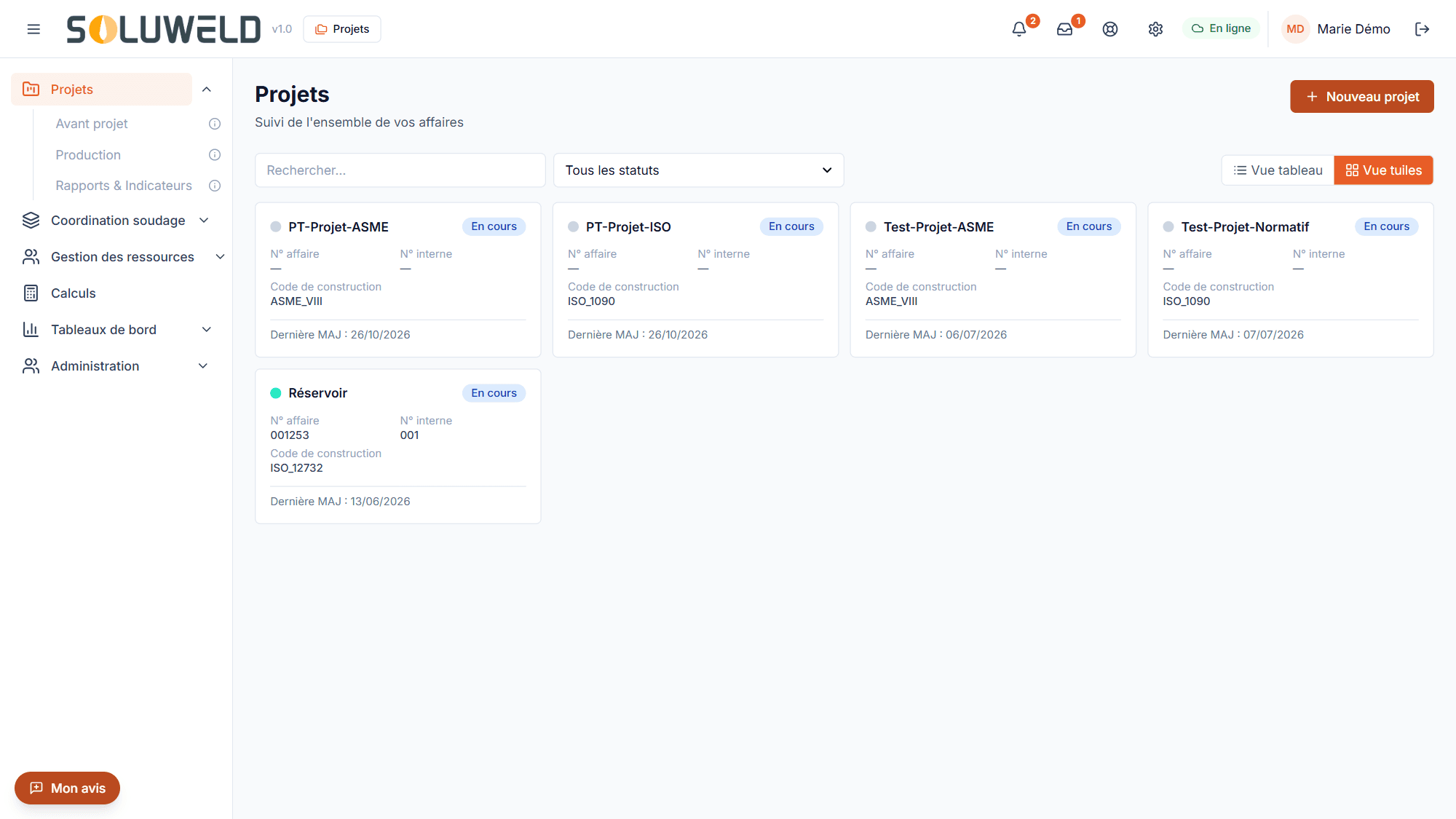
The inspection, attached to its weld
Non-destructive tests are recorded on the weld they concern: method, report, inspector, result. A repair stays linked to the original weld.
- NDT by method: VT, PT, MT, UT, RT
- Reports attached to the inspected weld
- Repairs traced through to acceptance
Manufacturing records, built as you go.
The weld book and the manufacturing record are composed from production data. They are always up to date and export to PDF on demand.
- Weld book composed section by section
- Manufacturing record exported to PDF
- Client comments on the weld book tracked and answered
What is welding coordination?
Welding coordination covers the tasks and responsibilities that ensure the quality of a company’s welding operations: from the review of the customer’s requirements to the manufacturing record handed over at delivery.
ISO 14731 describes these tasks and responsibilities. Welding quality standards such as ISO 3834, or EN 1090 for steel structures, require coordination personnel who are appointed and competent to carry them out.
The welding coordinator’s tasks
- Requirements review and technical review of orders
- Selection of parent materials, filler materials and processes
- Procedure qualification: WPQR and WPS, under ISO 15614-1 or ASME IX
- Welder and operator qualification and follow-up, under ISO 9606-1 or ISO 14732
- Planning of inspections and non-destructive testing
- Heat treatment, traceability, non-conformities and manufacturing record
SoluWeld does not replace the coordinator, who remains responsible for their decisions. The software structures their data, computes ranges of qualification, flags expiring qualifications and builds the manufacturing record as production goes.
Frequently asked questions about welding coordination
Does a company need a welding coordinator?
As soon as it works under ISO 3834 or EN 1090, yes: these standards require appointed welding coordination personnel, whose tasks and level of competence follow ISO 14731. The expected level depends on the complexity of the work.
What is the difference between IWE, IWT and IWS?
They are three international qualification levels for welding coordination personnel: engineer (IWE), technologist (IWT) and specialist (IWS). ISO 14731 itself speaks of comprehensive, specific or basic knowledge, depending on the tasks assigned.
Does welding coordination software replace the coordinator?
No. The coordinator remains responsible for technical choices and their approval. Software such as SoluWeld takes the document compilation off their hands: range-of-qualification checks, qualification expiry tracking, weld traceability and manufacturing record.
Which standards does SoluWeld cover?
Steels, in arc and oxy-fuel welding, under ISO, EN and ASME codes: notably ISO 9606-1 and ISO 14732 for welders and operators, ISO 15614-1 and ASME IX for procedures, ISO 3834 and EN 1090 for organisation.
Evaluate the platform on your real projects.
Thirty minutes on video to measure the time saved on records and the autonomy SoluWeld brings to your teams.